
Multiple legacy desktop applications unified into one modern web application
At First American Financial — the world's largest title insurance company at the time of the engagement — the challenge was consolidating fragmented Windows desktop applications into a single, unified modern web experience for a distributed, mobile workforce.
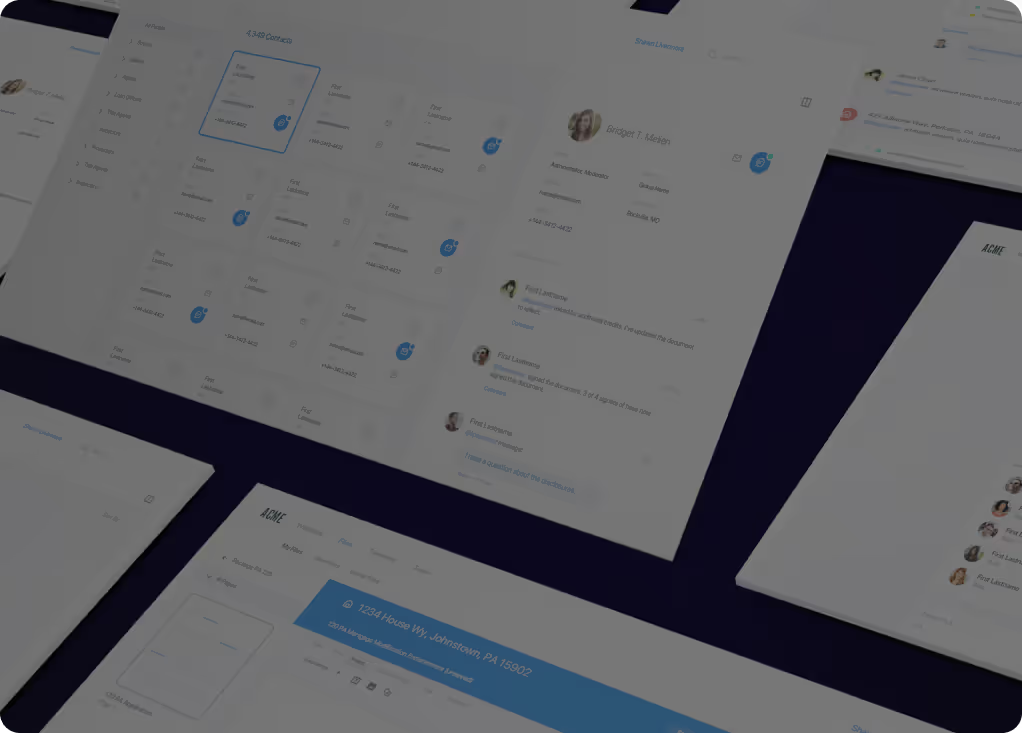

Fragmented desktop applications in an industry that had moved past desktop
First American Financial operated multiple Windows desktop applications across its title insurance operations. The business logic embedded in those applications worked — transaction processing, escrow management, document handling, and agent operations were all functional. The problem was the front end: inconsistent interfaces across applications, a desktop-only architecture in a workforce that had shifted to distributed operations, and no unified design language that a single team could maintain across the full application suite.
The ask was clear: bring the fragmented desktop applications into a single, unified modern web experience without disrupting the backend business logic that made the operations run. The goal was not a rewrite of what worked — it was a disciplined UI transformation built around what already existed.
A consistent design system built for a team to maintain at scale
The work began by mapping every desktop interface element to its web equivalent — text inputs, data grids, date pickers, modal workflows, escrow transaction views — while reconciling the new requirements that the desktop applications had never addressed: agent authentication, secure document sharing, mobile-responsive layouts, and real-time in-application document editing.
The result was a unified design system: a component library and visual design language that gave the organization a maintainable foundation for all future frontend work. Consistent navigation, consistent patterns, and a component architecture that a single team could evolve across the full application suite. The backend integration layer preserved the existing business logic in full while the frontend was rebuilt around it. The company received a modern enterprise web application it could actually maintain and extend.

What the new application made possible
Real-time document editing with assignment, version management, and user-to-user messaging within active transactions — replacing the fragmented tools agents had been working around.
Custom template composition with database field binding and real-time formula application — providing a level of document automation not previously available in the existing applications.
Comprehensive escrow transaction handling — financial data, document packages, and status tracking — organized in a consistent interface across all transaction types.
Regional performance metrics, daily work queue, and team-level reporting in a single dashboard — giving agents and supervisors the visibility they needed without navigating across multiple applications.
Active order tracking across hundreds of concurrent property transactions, with calendar and time-lapse views that could expand and contract to any zoom level the user required.
Structured document package handling with categorical classification, sort and filter capabilities, and drill-down access to every document within an escrow transaction.
Application screenshots
I personally designed and polished each user experience and helped the customer enact their desired business processes into their software.


The challenge in this kind of work is not technical — every component of a web application has a desktop equivalent. The challenge is design discipline: creating a component system where all of those elements behave consistently across the entire application suite, so that one team can maintain the full product without the fragmentation compounding over time.
Get the full case study
The complete case study documents the application UX guidance, design system approach, and the specific UI components built for the title insurance workflow — from document management to agent dashboards.
